
While Krishna V (KV) Rajan was the Indian Ambassador to Nepal, the Mahakali Treaty was signed between Nepal and India. Diplomat Rajan's book 'The Ambassadors Club', which has been claiming that this treaty is an important achievement of his tenure, is popular in diplomatic circles.

As soon as the new political and administrative map of Nepal was made public, the debate on the Mahakali Treaty (February 12, 1996) began. In this context, Kantipur Representative in Delhi Suresh Raj Neupane spoke to former Ambassador KV Rajan on the dimensions of Nepal-India relations :
How do you see the current border dispute and recent tensions between India and Nepal?
The current boundary dispute is due to a map drawn by the British East India Company in the nineteenth century. But India-Nepal relations are far more important than this dispute and its understanding. This problem should not cause tension in the relationship. Another thing is that the leadership and the people of the two countries should look to the future of both the countries. It is not right for Britain to stick to what it said two centuries ago. Our relationship is not one of looking at the past alone. We have to look ahead.
The main thing is whether we want a solution to the problem or not. We have to see what the solution is. For that, the government, civil society, political parties and the media must stand together. Both sides should have serious discussions and interactions on this issue. The current dispute does not seem necessary on the basis of the geographical, historical, cultural, social, economic and people-to-people ties between the two countries. This is not appropriate. I think both sides need to introspect so that there is no further damage to the relationship.
At the center of the current controversy is the source of the Mahakali / Kali. The Mahakali Treaty was signed when you were the Ambassador to Nepal. Why was the treaty made without identifying the source of Mahakali?
The Mahakali Treaty was proposed when Manmohan Adhikari was the Prime Minister. This is the proposal of the then UML government. The main part of the treaty was the Pancheshwar project, and there was no dispute over it. The project was said to be built on the border of both the countries. The goal was to divide water and electricity in half and bring economic prosperity to both sides of the border. That is why there was not much debate about the source when the Mahakali treaty was signed. Later, the issue of springs was raised. Despite the dispute, both sides were confident that it could be resolved. Although the issue of the source of the Mahakali was not directly related to the Pancheshwor project, it did not arise much during the treaty.
During the Mahakali Treaty, the issue of the source was said to have been 'intentionally sidelined'. Do you think you had a role in that?
That's not it. The issue of the treaty was first discussed during the UML government and later resolved during the Sher Bahadur Deuba government. At that time, there was no discussion about the source. Later, during the IP Gujral government in India, the 'instrument of ratification' of the treaty was exchanged. At that time, Lokendra Bahadur Chand was the Prime Minister of Nepal. Bamdev Gautamji, who had earlier opposed the Mahakali treaty, was also in the government. Later, when Gujral Saab went to Kathmandu, it seems that the issue was raised during the review of bilateral issues. It is also natural to raise the issue of springs when all issues are raised. But at that time there was not much discussion on that issue.
In your interview to Kantipur, you called the Mahakali Treaty the greatest achievement of your tenure. But even for 23 years, the DPR of Pancheshwor has not moved forward. Hasn't India completed the work including the link road which should be taken forward as per the treaty?
This seems to be a problem, especially due to differences in thinking. Water and hydropower agreements are complex issues in themselves. There is a dispute between different states of India over water. As it is a complex issue, the people do not understand the agreement reached at the political level, which gives an opportunity to the opposition to play. They create suspicion among the people. But the main thing is to rely on political will and transparency. Some weaknesses have also come from the technical side. India is equally responsible for this. I think there is an unnecessary delay in the technical side from the Indian side, which has caused the Pancheshwar meeting to be unnecessarily prolonged and postponed. This problem is also present in other projects. This is very unfortunate. The people of both the countries have to pay the price. The Mahakali Treaty had caused a great stir in Nepal's politics. The parties themselves were divided.
Are you accused of lobbying hard to get the treaty ratified?
We had discussions with all parties in a completely transparent manner. There were no pros and cons. We tried to explain to all sides of the treaty why it is in Nepal's interest. It is not that it is not beneficial for India either. The treaty was of special importance to Nepal. It was believed that the implementation of the treaty would open the door to immense potential for Nepal. It could have been a cornerstone for Nepal's economic prosperity. That is why we had healthy and transparent discussions with all parties. Due to the same discussion, those who were in opposition earlier also supported it later. They must also think that the treaty is in Nepal's favor.
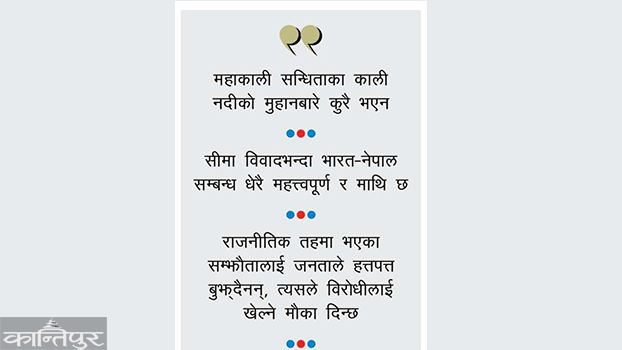
At that time, there were two sides in Nepal opposing the treaty. Due to which no hydropower agreement could be reached for a long time. The first is to say no to any agreement with India, the second is to protest by raising the issue of environment, displacement and cost. There were people in all parties who said that there should be a treaty. There were many leaders who said that it was in the overall interest of Nepal rather than for India. I still remember, perhaps in your own magazine, the day after the treaty was published under the headline 'Equality at Last'. At that time, the atmosphere in Nepal was wonderful.
There was a positive message that an equal agreement had been reached with India. Protesters are not alone. Even within the then UML, there was a faction in the opposition that asked why it should do so during the time of the Congress. Even now, I remember, a speech by the current Prime Minister KP Sharma Oli changed the whole atmosphere. Young politicians were in favor of the treaty. Some of the older generation were against it. But the main thing is that we have made the treaty possible through transparency and continuous discussions between India and Nepal.
Unfortunately, the same lack is seen now. That is why the current situation has been created. At that time, there was constant contact between the leaders. The prime ministers were in constant discussion with the ambassadors. The Prime Minister of India was personally interested in Nepal. Personal discussions and dialogues were held at the Prime Minister's level. Gradually that era came to an end.
What is the main reason for the lack of communication and communication in the current problem?
Of course. It is a fact that there was no contact and dialogue like then. The current political leadership is not interested in that kind of relationship. That is why there is a situation of doubting each other. Nepal should be skeptical when India makes some decisions and India should be skeptical when Nepal makes some decisions. That would not have happened before. Usually there were discussions between the two sides which could not be a house of mistrust and suspicion. Both sides had faith in each other, no one would think or do harm to each other. Both countries attached great importance to each other's thoughts and ideas. Mutual attitudes and thinking also play a big role in public relations. But, ironically, that's not the case now.
Work is underway to issue a public statement. There are some things that can be known from the media. This is not in line with the spirit of India-Nepal relations. At that time, there was a lot of thinking about how to strengthen the relationship between the two countries, whether it was between the leadership or the civil society. That is why mutual meetings and discussions were also focused on that. Moreover, India used to be more interested in how Nepal's interests are served. It was said that the relationship should be strengthened in the long run rather than immediate benefits. Due to the same positive thinking, the trade treaty was also reviewed.
I would like to recall an incident of that time. The Nepali side wanted to include some provisions in the trade agreement. Our government was of the view that its private sector would not comply. Prime Minister Sher Bahadur Deuba was on a visit to Delhi. P Chidambaram was the Commerce Minister of India at that time. Chidambaram met Deuba and informed him that it was not possible as Nepal wanted. In the afternoon of the same day, a discussion was held between the private sector representatives of both the countries. They discussed how to move forward on economic and investment issues by putting aside border disputes. During the discussion, the Indian side agreed with the Nepali side. Later, Chidambaram went to Deuba and apologized and said that he would withdraw his statement.
The reason I have raised this issue is that borders have their own significance in terms of nationality. But more than that, we have to look at what is in the interest of the people. The work was done in the same spirit. But now it is lacking, which has led to growing mistrust and apprehension on both sides. The result is the current tension.
Speaking of the Mahakali Treaty, you mentioned the issue of leader Oli. What was Oli's role like?
As far as I understand, Oliji was still a nationalist and very stubborn leader. Oliji's first question regarding the Mahakali Treaty was: Does it benefit Nepal or not? When he became convinced. Then he began to bring others to his side. At that time, not only Manmohan Adhikari, but also Girija Prasad Koirala was in a dilemma as to why the treaty should be signed. But most of the young leaders were in favor of the treaty. Especially Oli and Nepal took a stand. Their main interest was in the interest of Nepal and the strengthening of relations between the two countries. Looking at it that way, I think Oli's role is very positive.
At that time, the Mahakali Treaty was not only approved by the parliament but also Oli, who was positive towards India, is now the Prime Minister. Has the relationship between India and Oli changed in the last two decades?
I do not wish to comment personally. Even when I was in Nepal, I used to hear that it is anti-India, it is anti-China. But, I think it's just an accusation. Both India and Nepal are democracies. Now the nationalist issue has become popular not only in Nepal but all over the world. Whether it is a democracy or a dictatorial country, many countries seem to be taking a nationalist line.
In your opinion, Oli's recent image is also a link in the same global wave?
To a large extent it seems to be. There may be other domestic reasons as well. If you look at it, the political leadership is taking the nationalist line everywhere. Not only in Nepal but also in India and USA. But I think it is not beneficial to have a nationalist point of view when talking about India-Nepal relations. We must think of building a bright future for both countries. Common interest and prosperity should be the priority.
In all the treaties and agreements of my time, the common interest and interdependence were given priority. This added to the excitement on both sides. The kind of economic and social problems that exist between us cannot be overcome alone. So there is no alternative to partnership and coordination, which was there before. But the mood now looks a bit different on both sides.
He said the Mahakali Treaty was indispensable for the economic prosperity of both the countries. But the treaty changed Nepal's political landscape. UML broke up. Some Nepali political analysts also call the Mahakali Treaty the starting point of Nepal's political instability. Do they claim that the Maoists also helped in thwarting the insurgency?
I do not agree with that. The Mahakali Treaty was made for the economic benefit of both the countries. The reasons behind the Maoist insurgency were inequality, discrimination and poverty in the society. I don't think the Mahakali Treaty is the main reason for the split in the UML. As I have said before, the rest of the process of the Mahakali Treaty went ahead while the government was in power after the first protesters. I remember that some of the leaders in the opposition said that we will come to the government in a few months, let's do it at that time. Disputes are not new in a democracy.
Therefore, it would not be fair to say that the treaty has created political instability in Nepal. At that time, India's thinking was clear. Whichever party has the government should support Nepal's economic prosperity and the relationship between the two countries should be further strengthened. At that time, the government in India also changed. But the understanding and trust between the two countries continued.
Talking about the relations between Nepal and India, the issue of Kalapani region comes up. In an interview with Kantipur at that time, if the facts and evidence confirm that the Kalapani region belongs to Nepal, did India say that it is ready to leave the region at any time? Do you still stick to that statement?
The two countries have said that the dispute over Kalapani and other border issues will be looked into by the Border Technical Committee and the Foreign Secretary level mechanism. That is to say, the discussion now focuses on facts and evidence. I am surprised that there is a level playing field between the two countries, but we are still in dispute over the British treaty and the map. The main thing is that nothing has happened for so many years. It is not enough to say that both sides have evidence. India is based on maps of 1857 and later. If Nepal disagrees, he must have some evidence. Therefore, both sides should peacefully discuss and communicate by putting forward evidence and facts. And finally a conclusion can be reached.
Not only Kalapani, there is no other issue that cannot be resolved. The relationship between the two countries is based on mutual trust and harmony. Therefore, mutual trust and harmony should be maintained. I think if Nepal wins trust and harmony, India will not look at that evidence. I still stand by that statement. Because India is clear about its borders. I think if Nepal shows the facts and evidence that it has made a mistake before, then India should not leave the Kalapani area. Therefore, if there is mutual trust and harmony, the solution of any problem including border will come out easily. But that is not the case.
How can the recent tensions between the two countries be addressed?
I am not in a position to say how to address the current mistrust and tension. That's what experts say. But the current situation is unfortunate. The relationship between the two countries is much older and stronger than the lines drawn on the map of the nineteenth century. The governments of the two countries should also take care of people-to-people relations. I think the people of both countries want prosperity, peace and mutual trust.
In the end, Delhi has said that the steps taken by Nepal from the publication of the map to the amendment of the constitution are under the direction of China. What is your opinion on this?
I consider this to be a surprise response to Nepal's decisions. The recent decision taken by Nepal has certainly embarrassed the experts. But, now that the whole process is over, don't get bogged down in it. Because the road is not closed. Still, I believe there are many solutions. In terms of relations between the two countries, these problems are nothing. Some complications have certainly been created.
Tambahkan Komentar