
The epidemic reduced the size of the budget, the first priority to life
One and a half trillion package targeted at private sector, ambition of 700,000 jobs
MP's budget reduced by 20 million, administrative expenses cut to raise additional resources
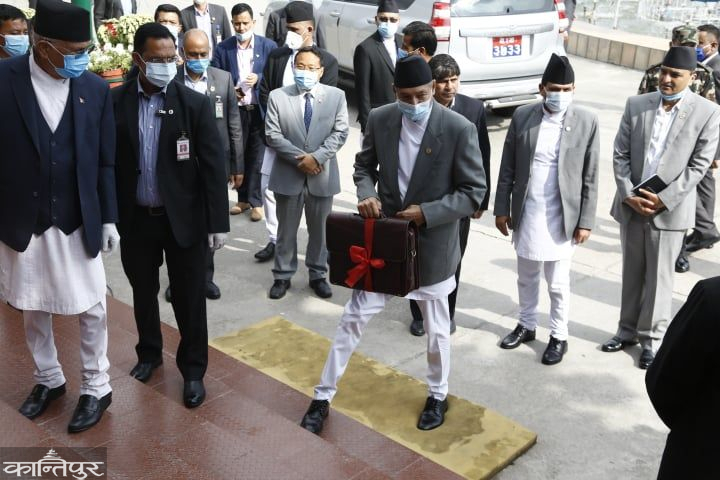
Finance Minister Yubaraj Khatiwada, who had failed to implement large-scale distribution-oriented programs in the previous budget, was advised by many not to do so this time. Khatiwada brought next year's budget on a smaller scale after suggestions and the impact of the global Covid-19 transition slowed down the Nepalese economy and put pressure on it.
However, due to lack of clarity in the implementation of many programs, the old risk of not being able to spend the full amount remains. The ambition to create jobs for seven million people, cost-cutting measures, and the implementation of health and agriculture programs have seen risks.
As per the budget presented by Finance Minister Khatiwada in the parliament on Thursday afternoon, significant budget has been increased in the health sector. There are some new programs in the agricultural sector. There are ambitious and difficult programs to be implemented in job creation. Efforts have also been made to provide relief and facilities from the Social Security Fund, which is reluctant to join the private sector. The budget has been allocated saying that it will create employment through the Prime Minister's Employment Program, which has been criticized for misuse.
"As the budget is getting better from many points of view, there are more challenges in the implementation," said Min Bahadur Shrestha, former vice-chairman of the National Planning Commission. Now, the continuation of Kovid-19 and the border dispute are likely to bring more challenges. He suggested that the government should immediately focus on implementing its resources and capacity.The old has been given continuity without any new and popular program in infrastructure and development. Budget allocation for urban development and infrastructure sector has also been made on par with the previous budget. A policy has been put forward to reduce the budget of the re-election constituency by Rs. 20 million and to reduce public expenditure.
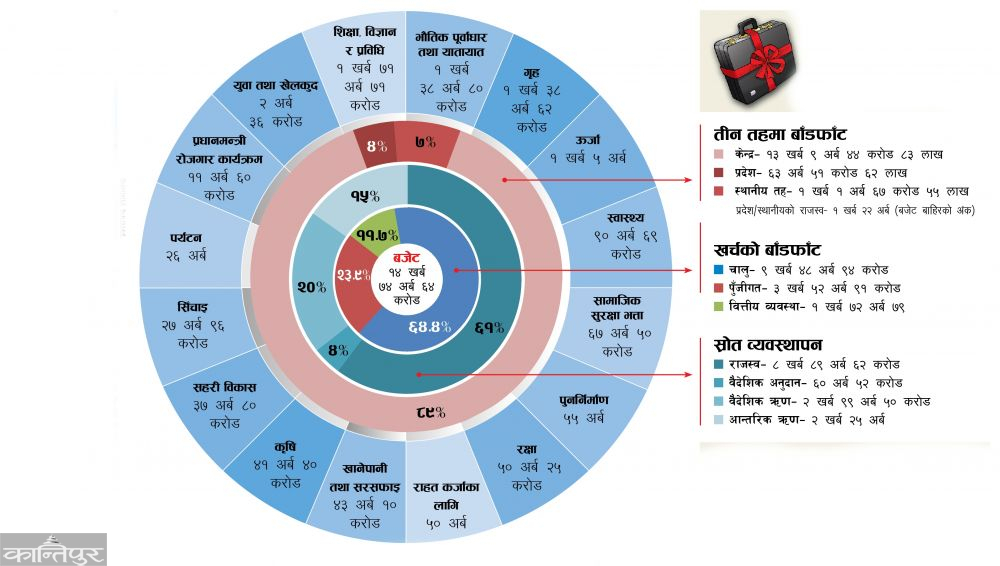
Khatiwada has brought a small budget ignoring the limit of Rs 17.5 trillion set by the National Planning Commission and the directive of the Finance Committee. The budget of the federal government presented in the parliament for 2077/78 is 4 percent less than the current year. Khatiwada, who has brought a budget of Rs.The epidemic reduced the size of the budget
64.4 percent or Rs. 948.94 billion has been allocated for recurrent expenditure. 23.9 percent or Rs. 352.91 billion has been allocated for capital expenditure. The remaining 11 percent of Rs 172.79 billion has been allocated for financial management, said Khatiwada. According to former secretary Rameshwar Khanal, this is the second time in Nepali history that the size of next year's budget has been reduced compared to the current year. Earlier, the budget for 2059/60 was Rs 96.1 billion. The previous budget was Rs 99.8 billion, he said on Twitter. The government had no other means of mobilizing resources as the impact of the global Covid-19 slowed down economic activity and pushed revenue collection.
According to Finance Minister Khatiwada, the revenue collection in the current fiscal year is 74.4 percent or Rs. 827 billion compared to the annual estimate. On this basis, the target of total revenue collection for the coming year has been increased by about 22.5 percent to Rs. 1 trillion 11 billion. Out of this, Rs. 122 billion will go to the state and local levels for revenue sharing. The remaining 889.62 billion revenue is planned to be mobilized as a source of the federal government's budget. The remaining insufficient amount is Rs 299.50 billion from foreign loans, Rs 60.52 billion from foreign grants and Rs 225 billion from domestic loans.
Life saving is the first priority
Considering the uncertain impact of COVID-19, the budget seems to have given priority to the field of health manpower from health infrastructure. A budget of Rs. 90.69 billion has been allocated for the health sector. This budget is claimed to prevent infection and improve the health system. "I have allocated resources to increase the range of tests in high-risk areas to prevent further spread of corona infection, to establish additional quarantine centers with quality health check-ups, to provide reliable treatment services and to address the psychological distress created among the citizens," Khatiwada said. A budget of Rs. 6 billion has been allocated for medicines and equipment that are urgently needed for corona control and treatment.
In the current fiscal year, a budget of around Rs. 4 billion has been released for Corona targeted programs. It has been announced to provide free health insurance up to Rs 500,000 to all health workers working against corona and other infectious diseases. "I have provided incentive allowance for doctors, health workers and laboratory staff with personal safety equipment to motivate them for service," said Khatiwada.
A package of Rs 1.5 trillion targeted at the private sector
The current refinancing fund and a new fund of Rs 50 billion have been set up and the loan facility package of Rs 1.5 trillion has been put forward by the budget. The relief programs brought by the government earlier will be continued as long as there is a risk of infection. The budget has made provision to provide loan at 5 percent interest for the payment of wages of the workers of domestic, small and medium enterprises and corona affected tourism business and for running the business. A separate fund of Rs 50 billion has been announced for this.
"The fund, which will be operated through Nepal Rastra Bank, will have funds from the government of Nepal, government-owned public institutions and donors," the budget said.
The budget has taken the policy of business promotion by increasing the budget of the existing refinancing fund. "Nepal Rastra Bank (NRB) has made arrangements to provide refinancing facility of up to Rs. The government has provided Rs 1.5 trillion for private sector targeted relief facilities.
The budget has also provided various government service fee waivers to industrialists. "Domestic small consumers consuming up to 10 units per month will be given free tariff, those consuming 150 units per month will be given 25 percent tariff and those consuming up to 250 units will be given 15 percent tariff exemption," the budget said. I have made arrangements to give concession in tariff.
The budget has also made arrangements to waive the demand fee of electricity during the lockdown period of the manufacturing industry and 50 percent discount on the consumption of electricity when the demand is low. It has also been announced that the amount to be deposited by the workers and employers in the social security fund based on the contribution of the workers in the organized sector will be borne by the Government of Nepal for a period of time. Provision has been made for the concerned establishment to receive the amount as a loan for immediate payment of the wages of the workers and to deposit it in the fund as soon as the business becomes comfortable. Shekhar Golchha, senior vice-president of the Federation of Nepalese Chambers of Commerce and Industry (FNCCI) said that the government would pay 21 percent of the contribution to the fund but it would have to be re-deposited later. "The budget doesn't talk about paying workers and cutting workers," he said.
It has also been announced to waive parking fee, air service license renewal fee, flight qualification certificate fee and infrastructure tax on aviation fuel to be paid by Nepali Airlines. Mentioning that starting capital will be provided at 2 percent interest rate to the innovative entrepreneurs who use the opportunity of Corona, a budget of Rs. 500 million has been allocated for that.
It has announced to give exemption in license and equipment renewal fee to address the impact of Corona on construction, transportation, mass media, film and other sectors. "I have made arrangements for loan facility and contract for lockdown period and extension of bank guarantee for working capital," Khatiwada said in his budget statement.
Officials at the Ministry of Finance have estimated that the relief amount for all these programs will be equal to 5 percent of the gross domestic product (GDP). The private sector has also been demanding a fiscal stimulus package equal to about five percent of GDP.
Golchha, senior vice-president of the Federation of Nepali Chambers of Commerce and Industry (FNCCI), said that despite the announcement of a relief package of around 5 percent, there is no excitement. "It simply came to our notice then. As we asked, the address was mixed, 'he said. It also seems to be greedy without finding the day. It was not addressed very clearly. He said that the problem of the private sector depends on the implementation of the budget.
The budget has also provided relief to the workers of organized and unorganized sectors. Corona-affected unorganized sector workers, on the other hand, will receive one-fourth of the minimum wage as food relief. Despite the government's announcement to move forward with the same concept after the lockdown, its implementation has been slow.
7 lakh employment ambition
The government has put forward a policy to create employment for 734,000 people next year through programs that are not being run effectively at present, are being criticized as controversial and distribution-oriented. The budget has claimed that 200,000 people will get employment next year from the Prime Minister's Employment Program which started two years ago. Out of the budget allocation of Rs. 5 billion this year, Rs. 11.60 billion has been allocated for next year.
The budget aims to create employment through newly launched programs such as the Poverty Alleviation Fund, the Youth Self-Employment Fund on the Way of Failure, and the Skill Transformation from the Labor Information Bank. Efforts are being made to link these programs with the private sector.
The budget has announced that if the private sector ensures two years of employment for the workers recommended by the Labor Information Bank, they will bear 50 percent of their salary for three months. A budget of one billion rupees has been allocated for this salary grant.
In order to displace Indian workers in Nepal, it has been stated that compulsory labor approval is required in the government bodies of Nepal. According to economist Bishwa Poudel, the government's goal of creating employment for 7.5 million people will not be achieved by the said policy. "Last year, there was an arrangement to work in Nepal only with a labor permit. But the government has not been able to come up with any statistics on how many Indian workers work here, 'he said. On top of that, what will he do if he adopts a policy like ours for Nepalis going to India? '
He also said that the government's goal of creating employment through employment and skill development is impossible. "The budget of the Prime Minister's Employment Program is being distributed by Damasahi. Weeding out cash distribution program cannot be called job creation, 'he said.
MP's budget reduced by 20 million
Finance Minister Khatiwada, who could not get rid of the controversial 'Local Infrastructure Development Partnership Program', has cut the budget by Rs 20 million. He said that Rs 9.90 billion has been allocated for 165 constituencies at the rate of Rs 60 million and only Rs 6.60 billion has been allocated for the budget next year. On this basis, the budget of Rs. 40 million for the constituency will now be available in the hands of the parliamentarians. This budget should complete the remaining works of health and infrastructure development, said Finance Minister Khatiwada.
There is also a commitment to other constituency-targeted infrastructure programs after cutting this budget. "In order to make the distribution of resources equitable in all local levels and constituencies of the House of Representatives, an arrangement has been made to allocate budget for the development of one strategic road, electricity, agriculture, irrigation and river control infrastructure in each constituency," the budget states.
The program started at the rate of Rs. 250,000 in 2052 BS and was allocated Rs. 60 million in the current year. The federal government had allocated Rs 9.90 billion annually in the name of 165 constituencies. The provinces have also been setting up similar funds under different names and conducting programs in parallel. It is estimated that around Rs 22 billion will be spent on this title by both the Union and the states. Of this, only about Rs 3 billion has been reduced by this budget.
Reduce administrative costs to raise additional resources
The budget has been cut in the administrative sector to mobilize resources as more budget has to be allocated for low revenue, health, employment and economic packages. The budget has announced cuts in all types of allowances received by health sector workers involved in the treatment and prevention of infections.
Employees working in more than 20 government offices and agencies were given 50 to 100 percent allowance. Apart from this, meeting allowance, extra time allowance, food and meal expenses, risk allowance and other facilities have been reduced, said Khatiwada. There is also an announcement to issue a separate directive for austerity. It is mentioned that strict measures will be taken for fuel, office maintenance, domestic and foreign visits, low priority seminars, seminars, assistance and purchase of furniture and vehicles. It has also been announced that public bodies will be scrapped as suggested by the Public Expenditure Review Commission headed by economist Dilliraj Khanal.
But even this is not enough, said Khanal. "There is still a lot of room for improvement," he said. "Revenue will not come without a revival of the economy." We still had to focus on spending cuts. '
Even though the facilities for the employees have been reduced, the budget has provided housing construction, concessional loan facilities and insurance. The government will provide up to Rs 1 lakh corona insurance to temporary and contract service employees.
7 percent growth target
The government has announced that it will not allow any shortage of budget in the projects of national pride that are already in operation. The budget claims that construction will take place between Corona and that it will help in the economic growth of the coming year. "The project bank will be identified, evaluated, selected and prioritized at the federal level by operating electronically," the budget said. "A separate law will be enacted to make the implementation of large projects of national importance and transformational projects effective."
It has been claimed that immediate return will be given next year and the implementation of the project which will be completed within a year and the unfinished project under construction will be expedited. "Construction of strategically important economic, social and physical infrastructure projects is expected to move forward, post-earthquake reconstruction is expected to be completed and the service sector is expected to expand," the budget said. There is confidence that can happen. ' Based on this, the budget has estimated that the economic growth will be around 7 percent in the coming fiscal year. The current fiscal year is low, and on the basis of negative economic growth, the 7 percent target will not be met next year.
Tambahkan Komentar